 PineGot HVAC RepairsPineGot HVAC Repairs
Cool comfort, restored fast
Air conditioning repair service Santa Ana homeowners rely on starts with a straight diagnosis, not a sales pitch — we find why the system stopped cooling and tell you what it costs before any work begins. When a compressor quits during an inland heat wave, or a thermostat reads 82 while the vents blow warm, a fast, honest repair matters more than a glossy brochure. This crew works on residential and commercial AC, furnaces, and full HVAC systems throughout Santa Ana, from Floral Park to South Coast Metro, and most searches for AC repair near me here come from homes that just lost cooling on the hottest day of the week.
📞 Call (714) 242-5495
Text or call about your air conditioning repair service job — a quick photo helps us quote fast.
A firm, all-in price confirmed before we start — no surprises.
On time, done to standard, and tidy when we leave.
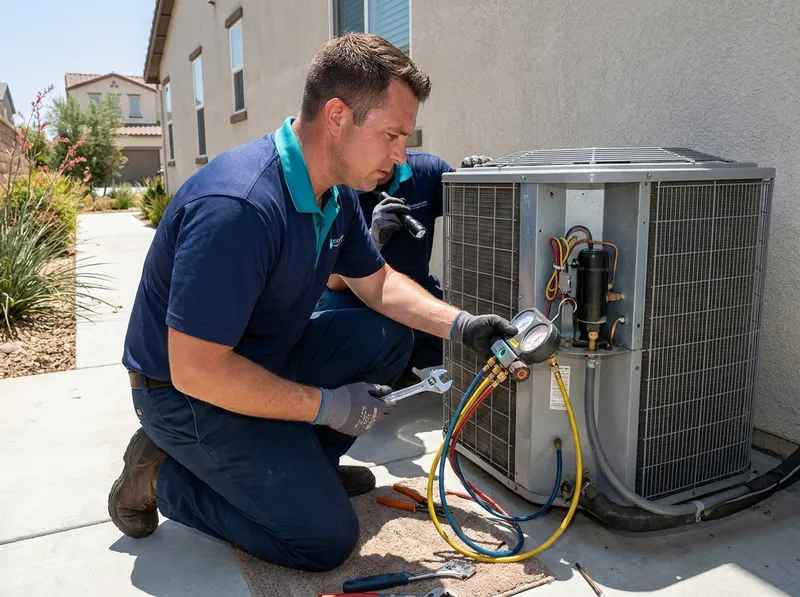
Emergency service makes sense when the problem cannot wait. A system that is blowing warm air during an inland heat spell, a breaker that keeps tripping, water pooling under an indoor unit, or an electrical or burning odor are all reasons to call now rather than schedule for later in the week. Homes near Delhi and along the flatter stretches toward South Coast Metro tend to hold afternoon heat, which is exactly when a dead compressor or blown capacitor gets noticed. If your AC is simply weaker than usual but still cooling, a standard scheduled repair is the cheaper, calmer choice; save the emergency visit for true no-cool or safety situations.
The trade-off is straightforward: emergency dispatch buys you speed and a same-day fix, but it carries the $150 minimum and, for after-hours timing, a higher labor rate than a routine daytime appointment. Common emergency faults are quick and affordable once diagnosed, capacitors, contactors, a tripped float switch, or a clogged condensate drain. Others, like a failed compressor or a refrigerant leak, need a longer conversation about repair versus replacement before you commit. The technician confirms the cause first and quotes the real number on-site so there are no surprises.
Santa Ana's mix of older and newer housing shapes what breaks. The 1920s and 1930s homes around Floral Park, West Floral Park, Fisher Park and Park Santiago often run retrofitted or aging systems where tight attic runs and dated wiring show up as summer failures. Bungalows in French Park, Wilshire Square and Washington Square frequently have compact side-yard condensers that overheat when airflow is blocked. Condos and rentals near Morrison Park and the South Coast Metro corridor lean on packaged and rooftop units that fail differently again. Whatever the setup, describe the symptom when you call so the truck arrives stocked for the likely repair.
Before the technician reaches you, a couple of safe checks can save time: confirm the thermostat is set to cool and the batteries are fresh, and check whether the breaker for the AC has tripped. If it trips again after a reset, leave it off and mention that on the phone, it points to an electrical fault worth flagging for safety.
| Emergency diagnostic / service call (minimum) | $150 |
| Capacitor or contactor replacement | $200-$450 |
| Clogged condensate drain or float switch clear | $150-$350 |
| Blower motor or control board repair | $400-$900 |
| Compressor or major component (after diagnosis) | $1,200+ / evaluated on-site |
Emergency AC calls in Santa Ana are prioritized for same-day arrival, often within a few hours. When you call (714) 242-5495 you get a firm arrival window before the technician leaves.
In Santa Ana, no cold air, a breaker that keeps tripping, water leaking from the indoor unit, or a burning smell are emergencies. A system that still cools but runs weak can usually be booked as a standard repair to save money.
Emergency AC repair in Santa Ana starts at a $150 minimum for the diagnostic and service call. The exact repair total is a ballpark confirmed on-site before any work begins.
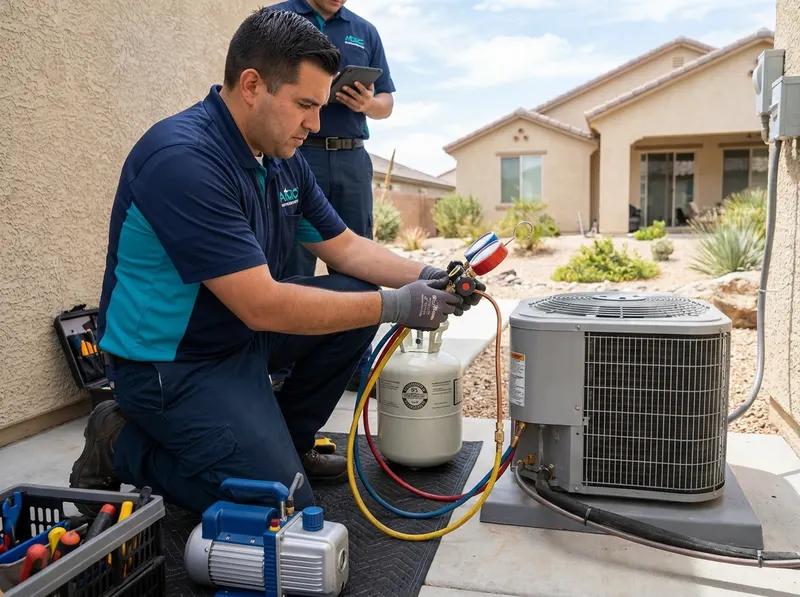
A weak, warm, or slow-cooling AC in a Santa Ana summer often points to low refrigerant, and low refrigerant almost always means a leak. Refrigerant is a sealed, recirculating charge that is not consumed during normal operation, so if the level dropped, something released it. Common leak points include the evaporator coil, the condenser coil, brazed line joints, Schrader valve cores, and the copper line set. We locate the exact source with electronic detectors and UV dye before touching the charge, so you pay to fix a problem rather than mask it.
A recharge-only approach fits one narrow case: a very small, slow seep on an older system where full repair is not yet cost-justified, and the homeowner accepts a shorter-term result. Leak repair plus recharge is the better decision for anything measurable, and it is the right call for evaporator or line-set leaks that will otherwise empty the system within a season. Older homes around Floral Park, West Floral Park, and Park Santiago sometimes run legacy R-22 equipment, and R-22 is expensive and being phased down, which shifts the math toward repair or full replacement rather than repeated recharges. Newer builds near South Coast Metro typically use R-410A or R-454B, where a clean coil or joint repair usually restores full cooling.
Santa Ana conditions matter here. Salt-influenced coastal air and years of heat cycling near French Park, Wilshire Square, and Fisher Park accelerate corrosion pinholes on aluminum evaporator coils and copper joints. Condenser units baking on west-facing pads in Washington Square and Morrison Park see line-set stress from expansion and contraction. In Delhi and the flats toward Centennial Regional Park, older split systems frequently show leaks at the service valves. Knowing the local equipment mix means we bring the right refrigerant and gauges to the first visit rather than guessing.
We confirm the repair by pulling a deep vacuum, verifying the system holds it, then weighing in the charge to the nameplate specification instead of eyeballing pressures. That weighed charge is what protects your compressor and gives you the cooling you paid for. If a leak sits inside a badly corroded coil, we will show you the coil-replacement cost against the value of the whole system so the decision is yours, not a surprise.
| Minimum service / diagnostic visit | from $150 |
| Leak detection (electronic + UV dye) | $150-$300 |
| Recharge only, R-410A/R-454B (small top-off) | $200-$450 |
| Leak repair + recharge, R-410A/R-454B | $250-$900 |
| R-22 recharge (legacy systems) | $400-$1,200+ |
| Evaporator or condenser coil replacement | quoted on-site |
A recharge in Santa Ana typically runs $200-$450 for R-410A or R-454B systems, more for legacy R-22. Our minimum service charge is $150. The exact figure depends on refrigerant type and how much is needed, and it is confirmed during a free on-site visit.
If your Santa Ana system lost a measurable amount of refrigerant, you need the leak repaired, not just a recharge, because refrigerant does not get used up in normal operation. A recharge-only fix suits only very small seeps on older units and gives short-term results.
Refrigerant leaks in Santa Ana homes commonly come from corrosion pinholes on coils, failed line-set joints, and worn service-valve cores. Coastal-influenced air and years of heat cycling in neighborhoods like Floral Park and Washington Square accelerate that corrosion.
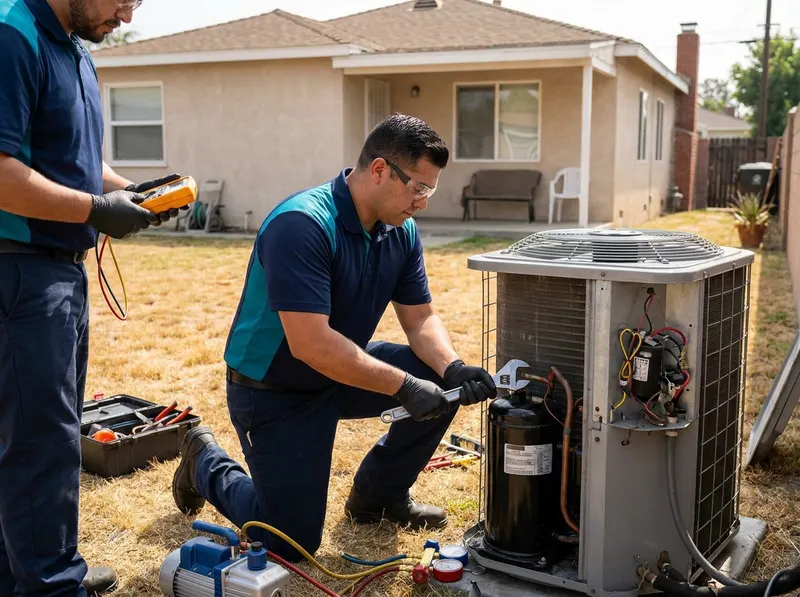
A failing compressor rarely announces itself cleanly. Around Floral Park and West Floral Park, where many homes still run older split systems added decades after the houses were built, the first sign is often warm air from the vents while the outdoor fan keeps spinning. In newer builds near South Coast Metro and the condos off the MainPlace Mall corridor, a compressor problem more often shows up as a hard-tripping breaker or a low, straining hum from the condenser. The diagnosis matters because not every no-cool call is a dead compressor — a failed capacitor, a burnt contactor, or a stuck start relay can mimic the same symptoms and cost a fraction to fix.
Repair fits when the compressor motor itself is sound and the fault sits in a supporting part. Replacing a capacitor or adding a hard-start kit can bring a hesitant compressor back to reliable starting, and that is the first path we test. Full replacement becomes the honest recommendation when the compressor windings are shorted, the unit has locked up mechanically, or the system uses aging R-22 refrigerant that makes ongoing repairs a poor long-term investment. On systems more than 12–15 years old, a compressor replacement often prompts a frank conversation about whether the whole condenser is worth replacing instead — the compressor is the single most expensive component, so a new one on a worn-out unit can be false economy.
Santa Ana's climate stresses compressors hard. The long, dry summers push condensers through Fisher Park, Park Santiago, and Morrison Park to run for hours at a stretch, and units near the 5 and 55 freeways or the Delhi area collect road grime and dust that insulate the coil and force the compressor to work hotter. Keeping the outdoor coil clean and the refrigerant charge correct is the cheapest way to protect the compressor you have. During any compressor visit in Washington Square, Wilshire Square, or French Park, we check charge and airflow so a repaired or replaced compressor isn't sent back into the same conditions that killed the last one.
Pricing on this service depends heavily on refrigerant type, tonnage, and whether the compressor is under manufacturer warranty. The minimum service charge is $150, and any compressor replacement quote is a ballpark until the exact model, refrigerant, and system condition are confirmed on-site at no charge. That on-site visit is where a real number gets set — no obligation to proceed.
| Compressor diagnosis / service call | from $150 |
| Capacitor, relay, or hard-start kit repair | $150–$400 |
| Contactor replacement | $150–$350 |
| Full compressor replacement (R-410A, typical residential) | $1,200–$2,500+ |
| Compressor replacement on older R-22 system | quoted on-site (often favors full condenser swap) |
A compressor that hums but won't start, trips the breaker, or runs while the air stays warm points to a compressor fault in a Santa Ana home. We test the capacitor, relay, and windings on-site to determine whether a low-cost repair will restore it or a replacement is needed.
AC compressor replacement in Santa Ana typically runs from around $1,200 to over $2,500 depending on tonnage and refrigerant type. Minor compressor-related repairs start at the $150 minimum. The exact price is confirmed during a free on-site visit.
On Santa Ana systems over 12–15 years old, replacing only the compressor is sometimes not worth it because the rest of the condenser is also worn. We give an honest comparison on-site so homeowners in areas like Floral Park and Park Santiago can weigh a compressor swap against a full condenser replacement.
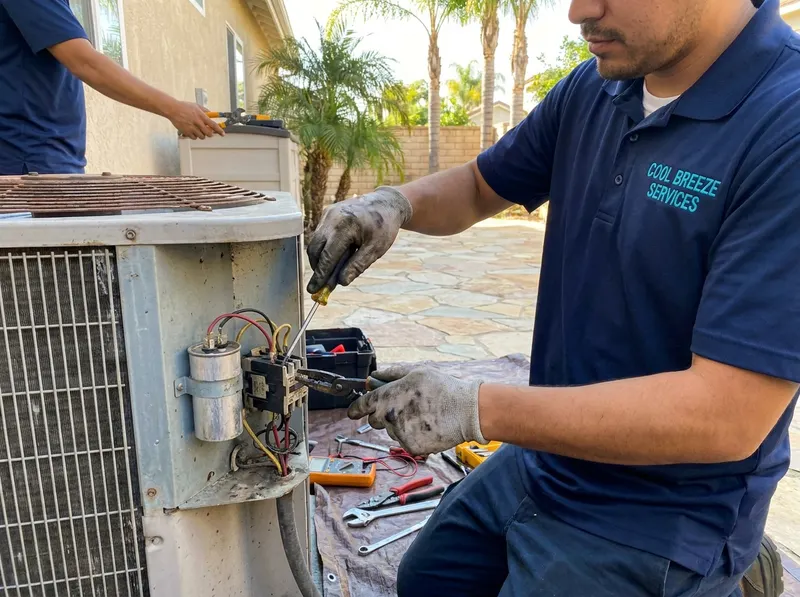
A dead capacitor and a failed contactor produce very similar symptoms, which is why replacement usually starts with a quick test rather than a guess. When a Park Santiago homeowner hears the outdoor unit humming but the fan won't spin, a swollen or leaking capacitor is the common culprit. When the thermostat calls for cool and nothing at all happens outside, a pitted or chattering contactor is often the reason. Both parts are inexpensive relative to the compressor they protect, so replacing them early is the frugal move.
Capacitors take a beating in this part of Orange County. Santa Ana summers run long, and units in West Floral Park and Fisher Park that cycle hard through afternoon heat push their capacitors past their rated tolerance faster than a mild-climate machine would. Contactors fail from a different cause: the constant open-and-close arcing burns the contacts over years, and dust and insects drawn into ground-level condensers near Delhi and Morrison Park speed that wear. Replacing the correct part with a matched microfarad and voltage rating matters more than the label on the box, so we verify the spec against the unit before installing.
Choose a capacitor or contactor replacement when the compressor and fan motors themselves are healthy and only the starting components have failed. This is the far cheaper path than a compressor or full system replacement, and it restores cooling the same day in most cases. The trade-off to know: if the capacitor failed because a motor is drawing too much current, or the contactor burned because of a deeper electrical fault, the new part will fail again quickly. That is why the start-up test after installation is not optional. If we see abnormal amp draw on a South Coast Metro rooftop unit or a Wilshire Square split system, we tell you straight so you are not paying twice for the same symptom.
Older condensers around Washington Square and French Park sometimes use a dual-run capacitor that serves both the fan and the compressor from one part. These cost slightly more than a single-value capacitor but are still a modest repair. For homes near Santiago Park Nature Reserve where units sit under trees, we also check for debris packed against the contactor that can cause it to stick — a five-minute cleanout that occasionally saves a full part swap.
| Single run capacitor replacement | $150 - $250 |
| Dual-run capacitor replacement | $180 - $300 |
| Contactor replacement | $150 - $300 |
| Capacitor and contactor replaced together | $220 - $400 |
A humming outdoor unit with a fan that won't spin usually points to a failed capacitor, while total silence when cooling is called often points to a failed contactor. A Santa Ana technician confirms which part with a quick electrical test before replacing anything.
Most capacitor and contactor replacements in Santa Ana are done in a single visit, frequently under an hour once the correct part is confirmed. Cooling is typically restored the same day.
Santa Ana summers run long and hot, so air conditioners in neighborhoods like West Floral Park and Fisher Park cycle hard and push their capacitors past rated tolerance faster than units in milder areas. Heat is the most common cause of capacitor failure locally.
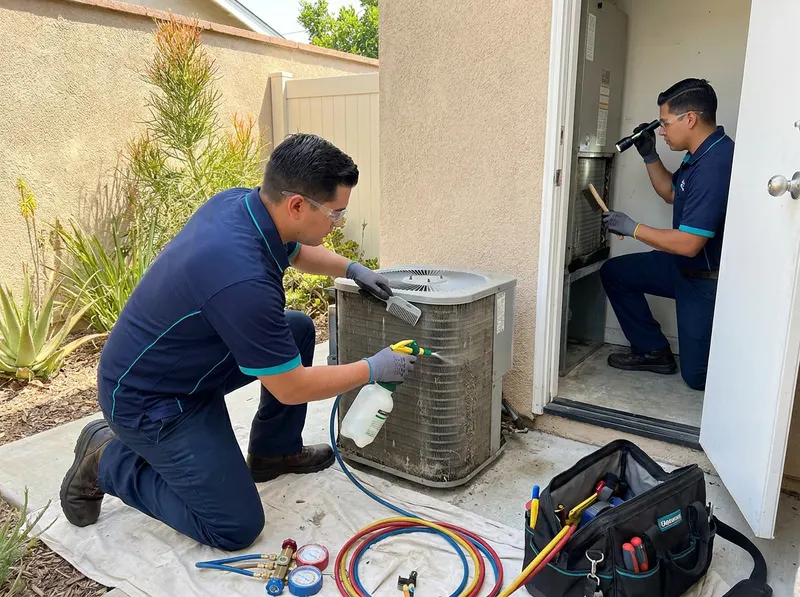
Coil service makes sense when your Santa Ana AC still runs but cools weakly, ices over, or the outdoor unit looks caked with dust and cottonwood fluff. Condenser coils in South Coast Metro and Delhi collect road grime from the nearby freeways and surface streets, while homes near Santiago Park Nature Reserve and Fisher Park pull in leaf litter and pollen that clogs the fins. A dirty condenser coil forces the compressor to work against trapped heat, which is one of the most common reasons for high summer bills across Orange County. Cleaning the coil restores airflow and heat transfer without replacing any parts.
Evaporator coil issues show up differently. If the indoor coil freezes, sweats heavily, or the drain pan overflows, the coil surface or the drain line usually needs attention. In older bungalows around Floral Park, West Floral Park, and Park Santiago, evaporator coils are often tucked into tight closets or attic air handlers, so access and careful cleaning matter more than raw speed. We inspect the coil, clear the condensate drain, and check for refrigerant leaks that can corrode the coil over time.
The main decision is cleaning versus repair versus replacement. Cleaning fits a coil that is intact but fouled, and it is the least expensive path. Coil repair fits a small, sealable leak or bent-fin damage. Coil replacement makes more sense when an evaporator or condenser coil has widespread corrosion or a leak that keeps returning, since patching a failing coil repeatedly costs more than it saves. We tell you honestly which category your coil falls into after inspecting it in person. If the coil is fine and the real problem is refrigerant charge, a stuck contactor, or airflow, we point you to the right fix instead of upselling coil work.
Santa Ana's dry inland heat and dusty Santa Ana winds age condenser coils faster than coastal areas, so an annual coil cleaning is a reasonable habit for homes from Washington Square to Wilshire Square and Morrison Park. Combining a coil cleaning with a broader tune-up is common, but coil service can also be booked on its own.
| Coil inspection with basic cleaning (single coil) | $150–$275 |
| Deep chemical/foaming condenser or evaporator coil cleaning | $225–$425 |
| Coil fin straightening and drain-line clearing | $150–$300 |
| Coil leak diagnosis and minor repair | $350–$750+ |
| Full coil replacement (parts + labor) | quoted on-site after inspection |
Evaporator coil cleaning in Santa Ana starts at the $150 minimum and commonly runs $150 to $425 depending on coil access and how much buildup is present. The exact price is confirmed after an on-site look; the figure over the phone is a ballpark.
In Santa Ana, a condenser coil likely needs service if the outdoor unit is visibly caked with dust and cottonwood, cooling has weakened, or bills have climbed. Homes near freeways in South Coast Metro and Delhi collect coil grime fastest and benefit from cleaning sooner.
A leaking coil in Santa Ana is a repair-or-replace decision, not a cleaning one. Small sealable leaks can sometimes be repaired, but a coil with widespread corrosion or a recurring leak is usually cheaper to replace than to patch repeatedly. We confirm which applies after inspecting the coil.
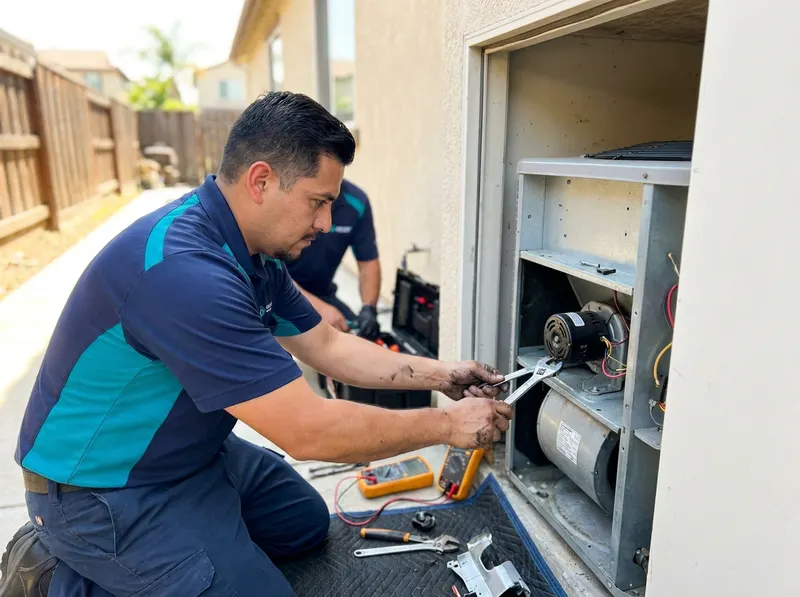
A blower motor fails in a few recognizable ways. The fan may not spin at all, it may run but produce almost no airflow at the vents, it may squeal or grind from worn bearings, or it may cycle on and off as an overheated motor trips on thermal overload. Before replacing anything, a technician checks the run capacitor and the motor windings, because a $30 capacitor sometimes mimics a failed motor. Confirming the actual fault first is what keeps this repair honest and keeps you from paying for a motor you did not need.
Repair versus replacement usually comes down to motor type and age. A standard PSC blower motor is often the more economical fix and pairs with an inexpensive capacitor swap. An ECM variable-speed motor costs more to replace because it includes an electronic control module, but it moves air more efficiently and runs quieter, which matters in the older two-story homes around Floral Park, West Floral Park, and Park Santiago where the air handler often sits in a hot upstairs closet or attic. If the motor bearings are only slightly worn and the system is otherwise young, a repair buys years. If the motor is seized, the system is aging, or the wheel is caked with debris, full replacement is the better long-term call.
Santa Ana conditions push blower motors hard. Homes near Delhi and the 5 and 55 corridors pull in more road dust, and the fan wheel and motor collect grime that forces the motor to work hotter. In the compact bungalows of French Park and Wilshire Square, ductwork is often tight and undersized, so a struggling blower shows up fast as uneven cooling between the front and back rooms. Newer condos and apartments around South Coast Metro tend to run ECM motors packed into small mechanical closets, where clearance for the swap is limited but the diagnosis is the same. Fisher Park, Morrison Park, and Washington Square homes with attic air handlers see thermal-overload cycling most in a summer heat spell, when the motor simply cannot shed heat quickly enough.
One practical note: airflow problems are not always the motor. A clogged filter, a closed-up return, or a dirty evaporator coil can starve airflow and make a healthy motor look bad. That is why the visit starts with a full airflow check across the system, not a parts guess. If the motor is genuinely the issue, you get a clear repair-or-replace recommendation and a confirmed price before any work begins.
| Blower motor diagnosis and airflow check | $150 minimum |
| Run capacitor replacement (blower) | $150 - $250 |
| PSC blower motor replacement | $300 - $500 |
| ECM variable-speed motor / module replacement | $450 - $650 |
| Fan wheel clean or replacement (add-on) | $150–$200 |
In Santa Ana, the clearest signs are weak or no airflow at the vents while the system still runs, a squealing or grinding noise, or a fan that cycles on and off. A technician confirms it by testing the motor, capacitor, and airflow before recommending repair or replacement.
It depends on the motor. In Santa Ana homes with a standard PSC motor, a capacitor or bearing repair is often cheaper; a seized motor or an ECM variable-speed unit usually calls for replacement. The on-site visit gives you both options with confirmed pricing.
Blower motor replacement in Santa Ana typically runs $300 to $650, with PSC motors on the lower end and ECM variable-speed motors higher. These are ballpark ranges; the exact price is confirmed on-site after diagnosis, with a $150 minimum for the visit.
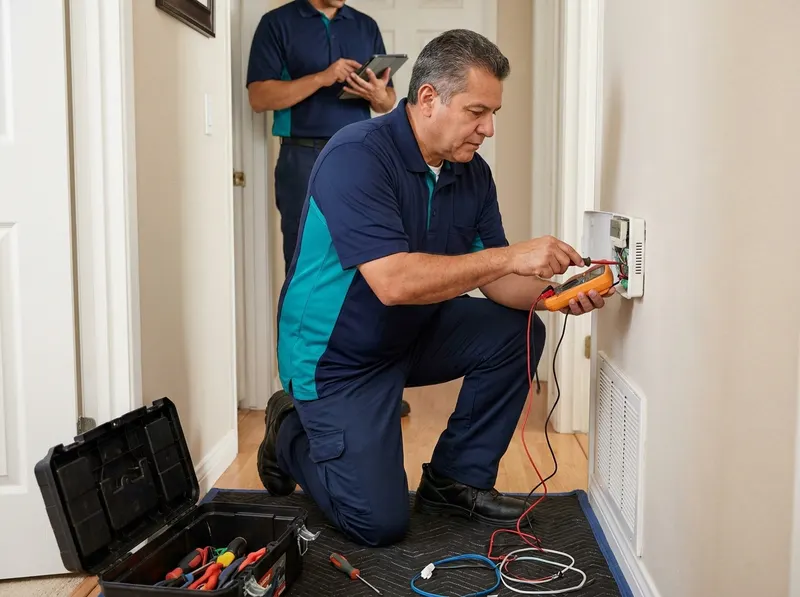
A thermostat is worth diagnosing first because its failures look exactly like compressor, capacitor, or refrigerant problems. In Santa Ana, a blank display, a system that runs nonstop, or rooms that never reach the set temperature can all trace back to a dead battery, a loose control wire, or a missing C-wire rather than the AC unit itself. Diagnosis confirms which it is, so you don't pay for a part the system doesn't need. That matters most in older Floral Park, Fisher Park, and Park Santiago homes, where original wiring behind the wall plate was never run for modern smart thermostats.
Thermostat replacement fits when the diagnosis shows a cracked screen, stuck relay, failed sensor, or corroded terminals — or when you're upgrading a basic dial thermostat to a programmable or Wi-Fi model. Repair alone fits when the issue is a loose wire, a tripped low-voltage fuse, or simple recalibration. The trade-off is straightforward: a smart thermostat adds scheduling and remote control that helps during long South Coast Metro cooling seasons, but it needs a C-wire, and adding one in a Washington Square or Wilshire Square home built without it turns a quick swap into extra low-voltage work. Diagnosis catches that before you commit.
Santa Ana's climate makes thermostat accuracy practical, not cosmetic. A unit reading two degrees warm keeps a system in West Floral Park or Morrison Park running longer than it should through summer afternoons. Proper placement matters too — a thermostat mounted near a west-facing window in French Park or in a hot hallway near the kitchen reads high and short-cycles the AC. Part of the diagnosis is checking whether location, not the device, is driving the complaint.
Every replacement is matched to your existing system's voltage and staging, whether that's a single-stage condenser in a Delhi bungalow or a multi-stage setup in a newer South Coast Metro condo. When a thermostat is confirmed as the fault, replacement and setup happen the same visit, and the new unit is tested against the running system before the job is called complete.
| Thermostat diagnosis (fault confirmation) | from $150 |
| Standard thermostat replacement (like-for-like) | $150–$300 |
| Programmable or Wi-Fi thermostat install | $200–$450 |
| C-wire add / low-voltage wiring correction | $150–$350 |
Thermostat replacement in Santa Ana starts at a $150 minimum and commonly runs into the low-to-mid hundreds. Cost depends on whether it's a like-for-like swap or an upgrade to a Wi-Fi model that needs added wiring. The exact price is confirmed on-site before work begins.
You often can't tell without testing, which is why diagnosis comes first for Santa Ana homes. A dead display, constant running, or wrong temperature reading can come from the thermostat or the AC unit. Diagnosis confirms the real fault so you only pay to fix what's actually broken.
Yes. Many older homes in Floral Park, French Park, and Park Santiago were wired before smart thermostats, so a C-wire is often missing. That wiring can be added as part of a Santa Ana thermostat upgrade, and the need for it is confirmed during diagnosis.
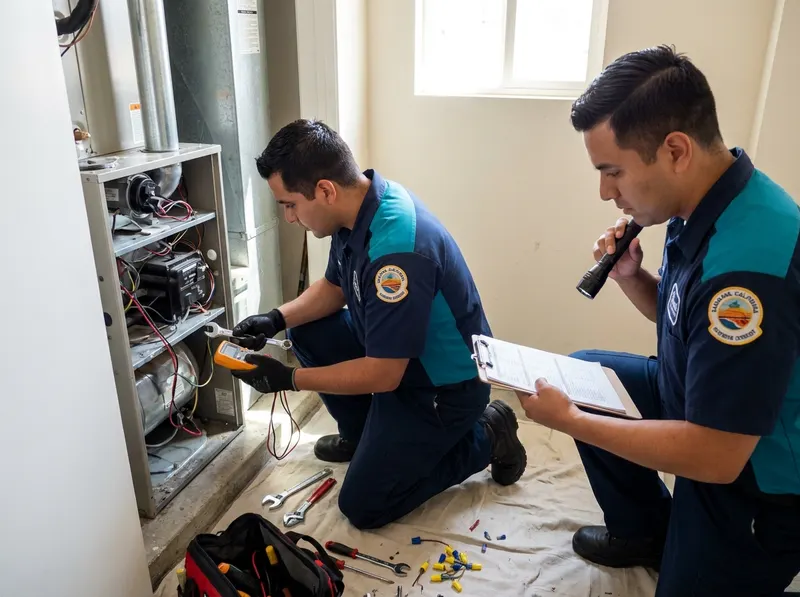
Because Orange County heating systems sit idle most of the year, the classic Santa Ana call is a furnace that ran fine last spring and now does nothing in November. The most common culprits are a dirty flame sensor, a cracked or worn hot-surface igniter, or a thermostat that lost its settings. These are targeted repairs, not full replacements, so a proper diagnostic matters before any part gets swapped. In older homes around Floral Park, French Park, and Fisher Park, the original furnace may be a decades-old gas unit tucked into a closet or attic, where age-related issues like a failing gas valve or a rusted heat exchanger show up. A cracked heat exchanger is a safety concern and gets flagged honestly rather than patched.
Repair is the right call when the furnace is under roughly 12 to 15 years old, the failure is a single component, and the rest of the system runs quietly and safely. Replacement becomes the smarter choice when the unit is well past that age, the heat exchanger is compromised, or repair costs start approaching a meaningful fraction of a new system. For newer homes and condos in South Coast Metro and around Washington Square, heat pumps are more common, and a heating fault there can share a cause with the cooling side, since one system handles both. That overlap is worth mentioning up front so the diagnostic checks the whole unit, not just the heat mode.
Santa Ana's coastal-influenced air and periodic Santa Ana wind events push dust and debris through returns, and a clogged filter or restricted airflow is a frequent trigger for a furnace that overheats and shuts itself off on the safety limit. Homes near Delhi, Morrison Park, and Park Santiago with long duct runs feel weak airflow first. A repair visit includes checking airflow and filter condition, since fixing the mechanical part without addressing airflow often means the same complaint returns.
Every visit starts with a diagnostic to confirm the exact fault before any work is quoted. Prices below are ballpark ranges for Santa Ana heating repairs; the exact figure is confirmed on-site after the system is inspected, and no repair is quoted below the $150 minimum.
| Heating diagnostic / minimum service call | $150 |
| Flame sensor clean or replace | $150 - $250 |
| Hot-surface igniter replacement | $180 - $350 |
| Thermostat replacement | $180 - $400 |
| Gas valve replacement | $300 - $600 |
| Blower motor repair or replacement | $350 - $650 |
| Control board replacement | $350 - $650 |
In Santa Ana, a furnace that won't turn on is most often a failed igniter, a dirty flame sensor, a thermostat issue, or a tripped safety switch. A diagnostic confirms which one before any part is replaced.
Furnace repair in Santa Ana typically runs $150 to $650 depending on the failed part. A $150 minimum applies to every visit, and the exact price is confirmed on-site after the diagnostic.
Yes. Santa Ana homes use both gas furnaces and heat-pump heating, and both are diagnosed and repaired. Heat pumps in areas like South Coast Metro handle heating and cooling in one unit, so the whole system is checked.
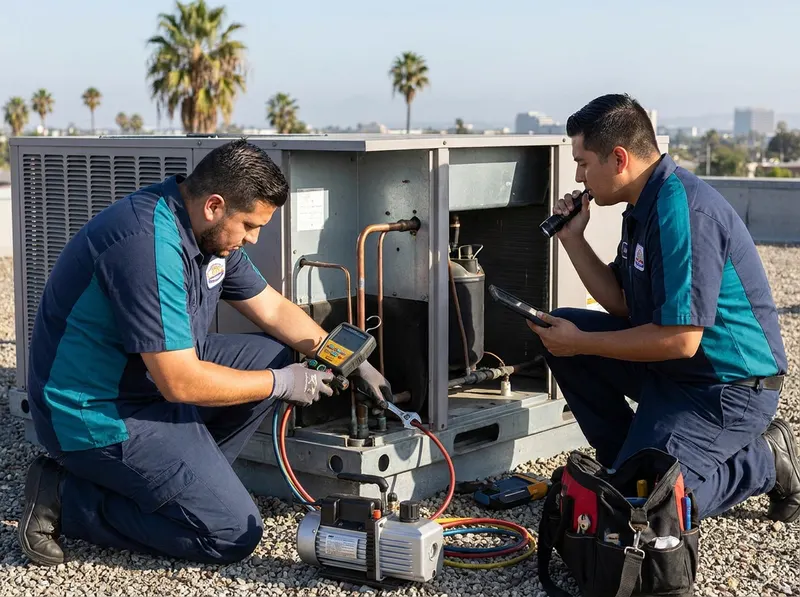
Commercial systems differ from home units in scale and complexity, which shapes how repair works. Many Santa Ana businesses run rooftop package units (RTUs) that combine cooling, heating, and airflow in one cabinet, and these face heavy sun exposure and dust that accelerate wear. Repairs often involve capacitors, contactors, blower motors, control boards, and refrigerant circuits — components that carry different specs than residential parts. A proper diagnosis identifies whether the failure is electrical, mechanical, or refrigerant-related before any part is replaced.
Decision-fit matters here: repair is the right call when a unit has a single failed component, holds refrigerant charge, and is otherwise within its service life. Replacement becomes the smarter choice when a rooftop unit is well past its expected lifespan, needs a compressor plus other major parts at once, or repeatedly trips on the same fault. For a South Coast Metro office tower or a MainPlace Mall-area retail suite, minimizing tenant disruption often favors a targeted repair over a full swap, while an aging restaurant RTU in the Downtown Santa Ana Artists Village that struggles through summer may be near the point where repair costs stop making sense.
Santa Ana's business districts each bring their own conditions. Restaurants near Fourth Street and the Artists Village generate kitchen heat load that pushes rooftop units hard through Orange County's long cooling season. Retail and office spaces around South Coast Metro and MainPlace Mall run long hours with high foot traffic, so airflow and thermostat accuracy directly affect customer comfort. Older converted buildings near French Park and Washington Square sometimes carry mismatched or dated equipment that needs careful diagnosis rather than guesswork. Light-commercial spaces along the Delhi and Morrison Park corridors often rely on split systems where the outdoor condenser and indoor air handler must be checked together.
A commercial visit starts with confirming the symptom, inspecting the unit safely on the roof or at ground level, and testing electrical and refrigerant readings against manufacturer specs. The exact price is confirmed on-site once the fault is identified, because a failed contactor and a failed compressor sit at very different ends of the range. Ballpark figures below give a realistic starting point for planning.
| Commercial diagnostic / service call | $150–$250 |
| Capacitor or contactor replacement | $180–$450 |
| Blower or condenser fan motor | $400–$900 |
| Control board or thermostat repair | $250–$700 |
| Refrigerant leak repair + recharge | $400–$1,200+ |
| Compressor-level repair (large RTU) | $1,200+ |
Yes. Rooftop package units are common on Santa Ana retail and office buildings, and repair covers their cooling, heating, electrical, and airflow components. Call (714) 242-5495 to schedule a rooftop service visit.
Commercial HVAC repair in Santa Ana typically ranges from $150 to $1,200 or more depending on the failure, unit size, and parts. The exact price is confirmed on-site after diagnosis, with a $150 minimum service charge.
Yes. Restaurant rooftop units near the Downtown Santa Ana Artists Village work hard against kitchen heat load, and repairs address motors, refrigerant, and controls that keep dining areas comfortable.
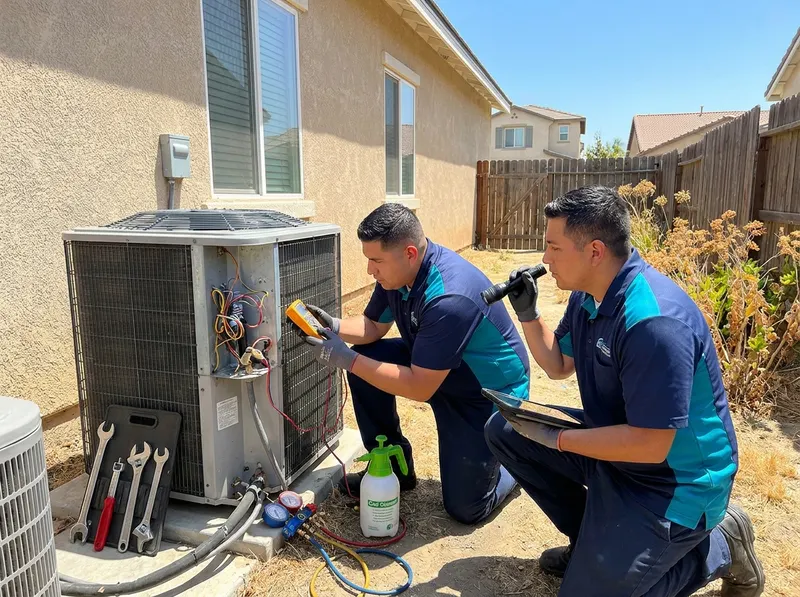
A pre-summer tune-up makes the most sense when your AC still runs but you want it checked before the heat load spikes. Santa Ana summers push afternoon temperatures well past comfortable, and a system that cooled fine in April can struggle once inland highs settle in. During the visit a technician cleans the condenser coil, checks refrigerant charge against the nameplate, tests the capacitor and contactor, and confirms the blower is moving enough air. These are the components that fail first under continuous runtime, so addressing them in spring is cheaper and less disruptive than an emergency call in peak season.
The tune-up is the right choice over a full repair when nothing is broken yet and you simply want reliability and lower running costs. If your system is already short-cycling, blowing warm air, or making unusual noises, a diagnostic repair visit fits better than routine maintenance, because those symptoms point to a specific fault that needs isolation. Homes in older neighborhoods like Floral Park, French Park, and Fisher Park often have systems that have been in place for many years; for those, a tune-up doubles as an honest condition assessment, and the technician will tell you plainly whether the unit is worth maintaining or nearing replacement. Newer builds around South Coast Metro tend to benefit most from coil cleaning, since fine dust from nearby traffic corridors collects on the outdoor unit.
Local conditions in Santa Ana shape what a tune-up actually finds. Condenser units in Delhi and along the busier stretches near MainPlace Mall pull in more airborne grit, which insulates the coil and forces the compressor to work harder. Homes in Washington Square, West Floral Park, and Park Santiago with mature tree cover often have leaves and seed debris packed into the outdoor cabinet. Cleaning that out restores heat transfer and directly lowers the amperage the compressor draws. Wilshire Square and Morrison Park properties with attic-mounted air handlers get a duct-connection and drain-line check, since a clogged condensate line in an attic can cause water damage once the system runs hard in summer.
Scheduling a tune-up in spring means a technician is not racing between breakdown calls, so there is time to test properly and explain findings. If a worn part shows up, you decide whether to fix it now or plan for it. Call (714) 242-5495 to book a pre-summer visit anywhere in Santa Ana.
| Single central AC tune-up | $150–$250 |
| Tune-up with minor cleaning add-ons | $200–$325 |
| Second system same visit | $150–$200 |
Most pre-summer AC tune-ups in Santa Ana take 60 to 90 minutes for a single central system. Homes with attic air handlers or heavy outdoor debris, common in Fisher Park and Park Santiago, may run a bit longer.
The best time to book an AC tune-up in Santa Ana is spring, before inland heat drives up demand. Scheduling in March through May means a technician has time to test thoroughly and fix small issues before summer runtime begins.
A standard Santa Ana AC tune-up includes reading and verifying your refrigerant pressure. If the system is low, that indicates a leak, and adding refrigerant is priced separately from the tune-up after the leak is discussed.
If your system is under 10 years old and stopped cooling suddenly, choose a targeted repair — a failed capacitor, contactor, or blower motor is usually a same-day fix well under the cost of replacement. If the unit is 12–15 years old, still uses R-22 refrigerant, and needs a compressor, weigh a repair against replacement, because a compressor is the single most expensive AC part and an old system may fail again within a season. If your rooms cool unevenly or the AC short-cycles, choose a diagnostic first rather than assuming the compressor is dead, since the cause is often a dirty coil, low refrigerant from a slow leak, or an oversized unit. If the outdoor fan spins but the house never cools, the problem is usually inside — a frozen evaporator coil or a blower that stopped moving air — and that points to a coil or blower repair rather than anything in the condenser. If the air smells musty or the vents blow weak, choose airflow and coil service before spending on refrigerant, since a choked coil mimics a low charge. The trade-off is simple: a repair gets you cold air today at the lowest cost, a replacement costs far more up front but ends recurring breakdowns and cuts summer power bills — and a proper on-site diagnosis is the only way to know which one your Santa Ana home actually needs.
| Service call & full diagnostic (on-site minimum) | $150 |
| Capacitor or contactor replacement | $150–$400 |
| Thermostat replacement (standard/programmable) | $150–$450 |
| Refrigerant leak repair & recharge | $350–$1,200 |
| Blower motor repair or replacement | $400–$950 |
| Evaporator/condenser coil cleaning | $200–$600 |
| Frozen evaporator coil thaw & diagnosis | $200–$450 |
| Furnace ignition/flame sensor repair | $150–$500 |
| Heat pump repair | $300–$1,200 |
| Pre-summer AC tune-up | $150–$300 |
| Commercial rooftop unit diagnostic | $200–$400 |
| Compressor replacement | $1,200–$2,800 |
Your exact price is confirmed before any work begins.
Santa Ana's older neighborhoods around Floral Park, French Park, and Fisher Park hold a lot of 1920s–1950s homes that were never built for central air, so many run add-on or older split systems that strain hard during inland heat waves. Those vintage homes often have undersized ductwork or a single return, which makes airflow problems and frozen coils more common here than in newer tracts. When the fall Santa Ana winds roll through, dust and debris pack into outdoor condenser coils faster than in coastal cities, which is a real cause of overheating and short-cycling we see across town, especially on units sitting close to unpaved side yards or busy roads. Because Santa Ana sits inland from the coast, afternoons here run several degrees hotter than in beach cities, so systems that would coast along near the water run flat-out for hours and expose weak capacitors and low charge fast. Newer builds and offices near South Coast Metro and MainPlace Mall lean on rooftop packaged units, so we carry parts and diagnostic gear for both the vintage residential systems and modern commercial setups this city actually runs. Homes near Santiago Park Nature Reserve and Park Santiago sit under mature trees, which means more leaf litter and pollen in outdoor coils each spring — one more reason a pre-summer cleaning pays off before June.
Neighborhoods we cover: Floral Park, French Park, Washington Square, West Floral Park, Park Santiago, Wilshire Square, Fisher Park, Morrison Park, Delhi, South Coast Metro.
Same-day service is available for most no-cool calls in Santa Ana, and emergency repair runs 24/7 during peak summer. Arrival time depends on how many calls stack up during an inland heat wave, so calling early in the day gives you the best window. You can also text a photo of your unit's model and data plate to speed up parts prep.
The on-site minimum is $150, which covers the service call and a full diagnostic. Common electrical fixes like a capacitor land in the $150–$400 range, while a compressor replacement runs $1,200–$2,800 — all prices are ballparks, and the exact figure is confirmed on-site before any work starts. Nothing beyond the diagnostic is charged until you approve the repair.
Repair usually wins when the system is under 10 years old or needs an inexpensive electrical part. Replacement makes more sense for a 12–15 year old unit on R-22 refrigerant that needs a compressor, because that system is likely to fail again soon and costs more to run through a Santa Ana summer. A technician confirms which path fits during the diagnostic and gives you both numbers before you decide.
In Santa Ana, an AC that cools in the morning but blows warm during the hot afternoon usually has a low refrigerant charge from a slow leak or a dirty coil that can't shed heat once the load climbs. Inland afternoon temperatures push the system to its limit, which is when a marginal charge or choked coil finally shows. A diagnostic finds which of the two it is before any recharge.
Yes. We repair rooftop packaged units and multi-zone commercial systems for offices, retail, and restaurants across Santa Ana, including the South Coast Metro corridor and near MainPlace Mall. We work around business hours where possible to limit disruption to customers and staff.
When the outdoor fan runs but a Santa Ana home won't cool, the fault is usually indoors — a frozen evaporator coil, a failed blower motor, or a bad capacitor stopping the compressor while the fan keeps spinning. Turning the system off to let a frozen coil thaw before the technician arrives can help, but the underlying cause still needs a diagnostic. It is rarely something you can fix at the thermostat alone.
We repair furnaces, heat pumps, and full HVAC systems throughout Santa Ana, not just air conditioning. Gas furnace igniter and flame-sensor faults are the most common winter calls, and heat pump repairs cover both heating and cooling modes. Winter is the slowest and most flexible season to schedule this work.
Late spring, April through May, is the ideal book-ahead window for a tune-up before summer demand peaks June through September. Winter is the slowest and most flexible season for non-emergency repairs, and fall Santa Ana wind events tend to spike short-notice calls when debris fouls outdoor coils.
Santa Ana wind events drive dust and debris into outdoor condenser coils, which blocks the unit from releasing heat and leads to overheating and short-cycling. Homes near unpaved yards, mature trees, or busy roads collect debris fastest. Clearing and cleaning the condenser coil after a wind event is a simple step that prevents a bigger repair.
Uneven cooling in a Santa Ana home often traces to airflow problems — dirty coils, a weak blower, undersized ductwork common in older neighborhoods, or a low refrigerant charge — rather than a dead AC. Many 1920s–1950s homes around Floral Park and French Park have single returns that make one side of the house warmer. A diagnostic pinpoints whether it's the equipment or the ductwork before any parts are replaced.
For a residential AC diagnostic in Santa Ana, an adult should be home so the technician can access the indoor air handler, thermostat, and electrical panel along with the outdoor unit. For commercial rooftop work, we coordinate roof and panel access with the property manager or on-site staff. Texting a photo of the unit and its data plate ahead of time helps confirm parts before arrival.